I recently learnt an interesting fact. I sometimes joke with my friends that when I learn something potentially dubious, I’ve learnt a myth. I think we may even have laughed about this before ‘fake news’ started becoming the way of describing such pieces of information. In any case, I think this interesting fact is undoubtedly credible.
This post is about the UK’s smallest bird: the goldcrest. And, according to Discover Wildlife, the goldcrest is one of a handful of birds whose scientific name is a tautonym. A tautonym is when the scientific name is identical for the genus (the first part) and the specific name (the second part). In the goldcrest’s case, this is Regulus regulus.

My partner and I were lucky enough to see a goldcrest on a walk in November. We’d just been talking about goldcrests, as I’d read an email from the Warwickshire Wildlife Trust which mentioned that winter is a good time to look out for these 6g critters (side note: apparently 6g is about the same weight as a 10 pence piece – mind. blown.) We were walking on a footpath by the side of a busy road. Next to the footpath was a line of coniferous trees and, as we were passing one particular conifer, we saw a teeny tiny bird flitting around. We stopped for more of a look and were delighted to see a revealing gold line on the bird’s crown, confirming its identity.
It was a very special encounter and I wish I had some proof of it. Sadly – and hilariously! – my partner did get his phone out to record the goldcrest. We were so close to it that it was recordable. However. Slight issue. He didn’t press record until the very end when the bird had flown further into the tree. So all he’d recorded was his finger and me saying ‘that was good’. I think I was almost on the floor in a fit of giggles when I realised what had happened!
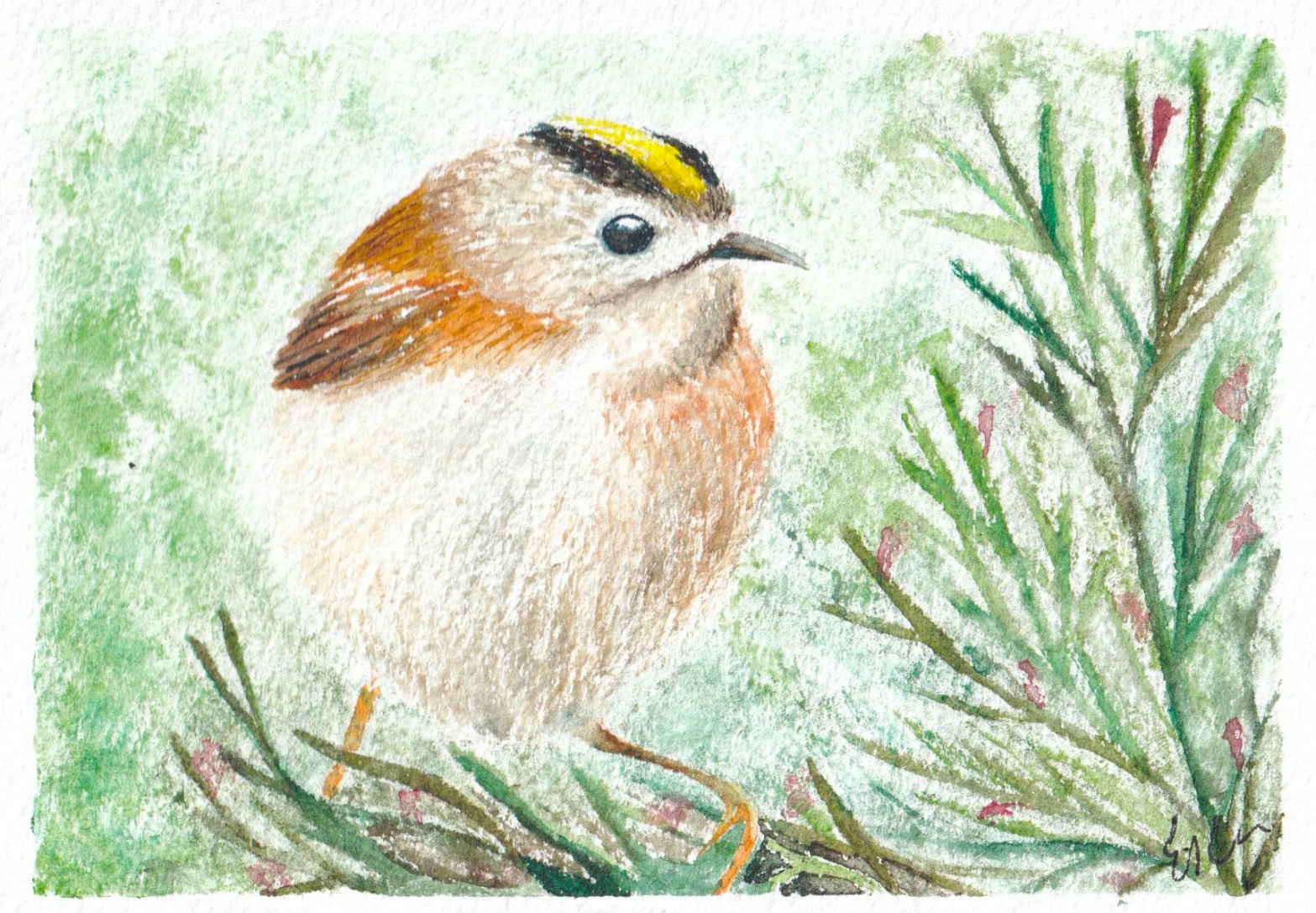
The walk was a long one (10 miles!) and I remember it being very muddy in places. But the thing that still sticks out the most is the beautiful goldcrest. And, particularly as we ‘lost’ the video footage, it’s been on my art-list since our November walk.
I started as usual by drawing out a vague outline of this little bird. I didn’t take a photo of this stage of the process but I was having a few doubts by the time I’d finished the outline. I imagine it’s something that gets easier with practice, but I still find it difficult to picture what the final piece will look like – and whether it’ll look right – before I’ve started adding colour and shade. A pencil outline isn’t very much to go on!
I wanted to use my Winsor & Newton pocket watercolour set for this piece. I tend to use watercolour tubes, but I’ve found that these can sometimes be a bit wasteful (usually because I don’t accurately predict the amount of paint I’m actually going to use!) so I got the 12 half pan set out.
Instead of wetting the paper first, I decided to try a different approach. I’ve seen lots of bird artists on social media make use of the white of the paper in their work and I thought more about what the piece would look like from a distance than up really close. Shapes and colours are really important to this so I tried to ignore most of the detail and refocused my attention. I also used the roughness of the paper to add texture to the bird’s feathers.

I made sure to add a bit more detail to the bird’s eye and beak and then moved on to the tree. Now, you might say that the background should’ve been done first and, to be honest, I’d completely agree with you. Thing is, I didn’t decide until I worked on the greenery that I didn’t want a white background so I had to improvise. Quickly. So I started splashing on some of the greens and browns from the watercolour set and, with no other bright ideas, I used my finger to spread the colour out. Mercifully, it worked.
Does that mean I’ve learnt another myth fact?
 Ramblings of a (very!) amateur artist
2 thoughts on “Regulus regulus”