356 Days Wild: Week 1

I’ve set myself a new challenge for 2021. A ‘wild’ one.

As those of you who have read quite a few of my posts may know, I’m a big fan of wildlife and the benefits it can have on wellbeing. A couple of The Wildlife Trusts’ challenges really brought this home to me over the past year (30 Days Wild and 12 Days Wild).

During these challenges, I could feel the weight of everyday life start to ease off me, but I’ve also found that I haven’t been keeping it up. So, in an effort to do just that, I’m starting a personal ‘356 Days Wild’ challenge for 2021.

Let me address the obvious question first. It isn’t a typo. It’s meant to be 356. You see, I had a moment of realisation on Friday 15th January. I was walking through the local meadow and was listening to the radio. It was all doom and gloom as usual so I took my earphones out and decided I needed to start paying attention to the wildlife around me again. And not just as a one-off. I also realised that it was a bit of a shame that I hadn’t had this epiphany on the 1st January or even on the 5th January when ‘12 Days Wild’ ended. So that’s why it’s 356 days – I can’t pretend to backdate the last 9 days to make it up to the full year!

Although I’ve pitched this as a ‘challenge’ for myself, my experience of ’30 Days Wild’ and ‘12 Days Wild’ taught me that encounters with the natural world and its wildlife can be as big or small as you like. Just noting down ‘a random act of wildness’ each day – even if it’s a teeny tiny thing – can be helpful. And, though I’m planning to post about my challenge each week, I can’t promise that it’s always going to be full of different, out-there things. Sometimes there might be a piece of art, other times there might not even be a photo. But hopefully writing about my challenge will continue to help me with my own wellbeing and might even give you a few ideas about how to enjoy the wildlife around you too.

So, here’s the start of my ‘356 Days Wild’ challenge:

Friday 15th January 2021

The highlight of my (very muddy!) walk was definitely the birds. I was lucky enough to spot two green woodpeckers, some goldfinches, some long-tailed tits and a moorhen. It made me think about my list of birds that I’d like to paint. I’ve already had a go at most of these but I reckon there’s room for another try at a green woodpecker – they’re just too colourful to resist!

My ‘rock’ during the various lockdowns – it might not look like it but this Shipston walk brightens up all my gloomy days!

Saturday 16th January 2021

I like to have a bit of background noise when I paint, draw or do things around the house. It was all about the chores this morning so I decided to find a new podcast. I searched for ‘wildlife’ on BBC podcasts and an unexpected one popped up. It’s called the Countryside Hour on BBC Radio Norfolk. I don’t live in Norfolk but I thought there wasn’t any harm in giving it a go. I listened to Chris the Norfolk farmer for 30 minutes. He reminded me that we’re heading towards increasingly longer days (win!) and also told a lovely story about 3 fox cubs on his farm.

Sunday 17th January 2021

I finally started to tackle some things in the garden today but that wasn’t the act of wildness I’m going to note down for the end of my first ‘week’ of 356 Days Wild. I’m sure it will feature in the future though! Instead, it was all about painting this chaffinch. I found this one a little difficult to do but I wanted to capture his vibrant colours and I think I managed to do that. 

Watercolour chaffinch

Any tips, advice or ideas for other ‘wild’ things to do are very much welcome! Looking forward to seeing what next week has in store – wish me luck!!! 😊

A winter visitor

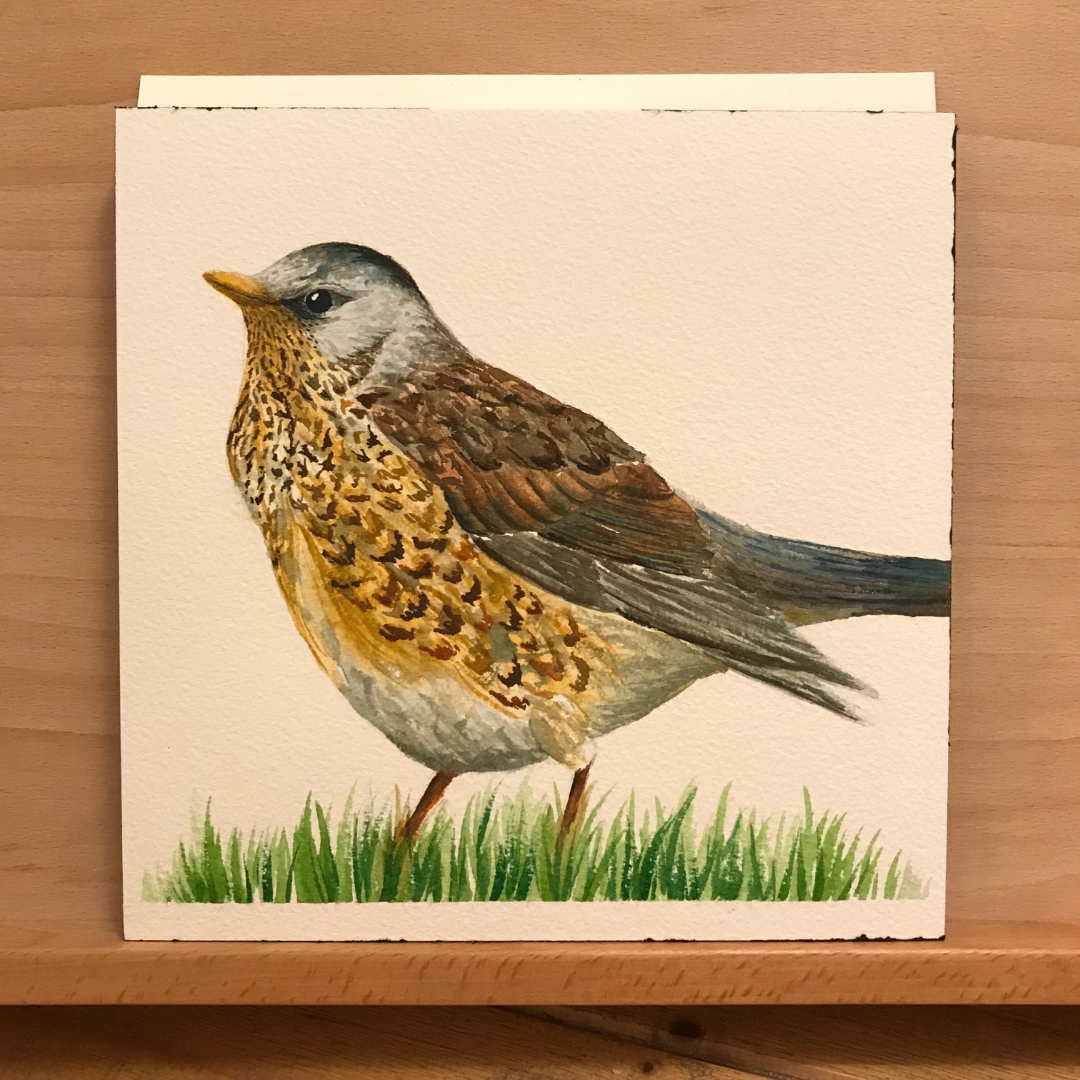
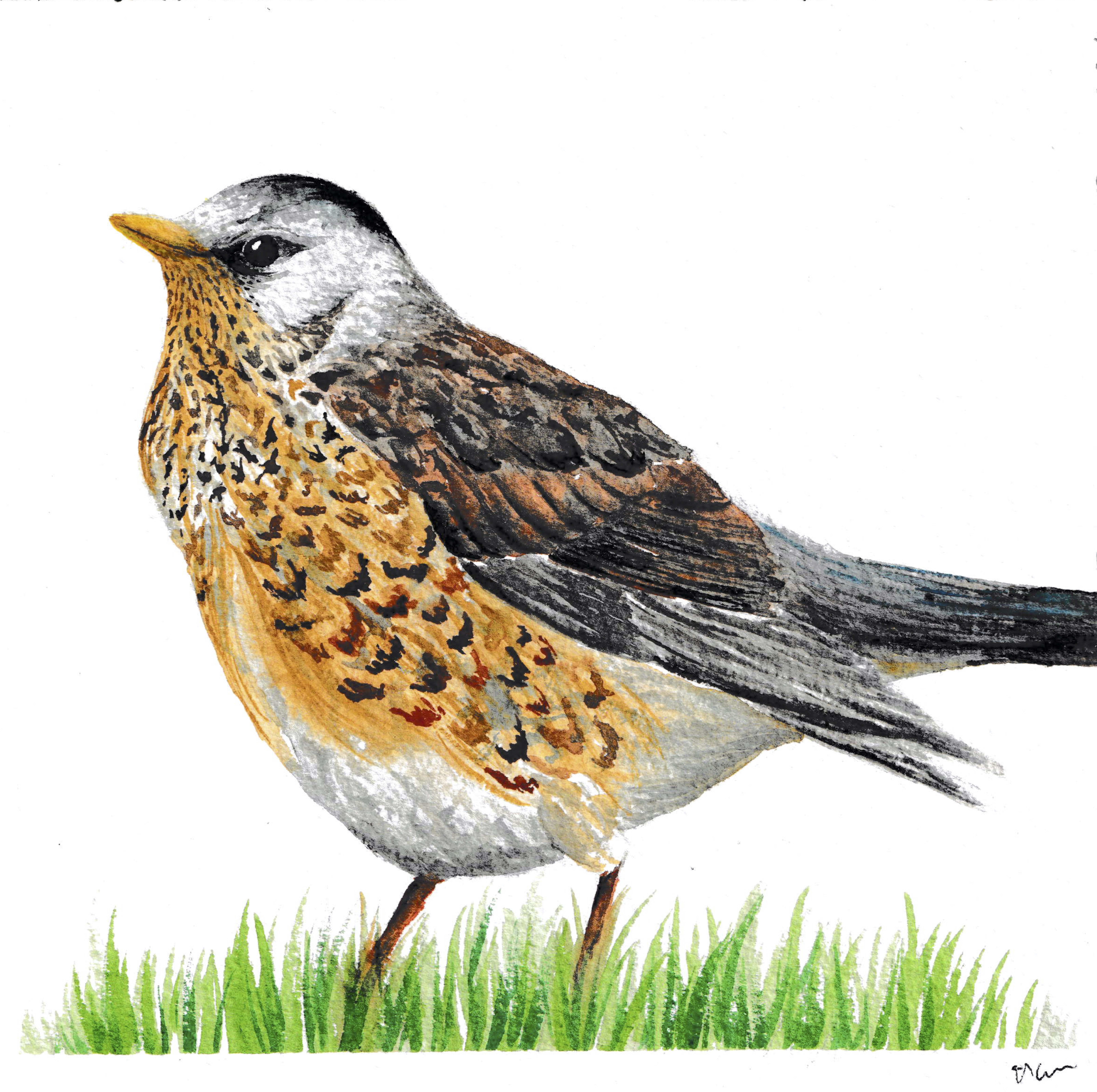
The winter visitor I’m going to write about today is the fieldfare. 

I first spotted a group of fieldfares towards the end of last year. I heard them before I saw them. It was a very odd noise and I wondered what on earth I was listening to. The British Trust for Ornithology describes the sound as a ‘harsh, aggressive sounding “chack chack”’. I remember it was a very muddy walk through the meadow and every time I tried to get a bit closer to the birds they just flew off into the next tree. I thought they moved a bit like blackbirds but they definitely didn’t look like blackbirds.

Perplexed and unable to get any closer to the birds, I carried on with my short stroll. I passed a couple walking the other way shortly afterwards and, after saying hello, I overheard one of them say ‘well, I think we saw something interesting there’. I was tempted to stop them and ask whether they were talking about the mysterious birds but I didn’t think that was a good idea (for a number of reasons!)

When I got home, I had a look in the bird book and wondered if the birds I’d seen were fieldfares. After going for a few other walks after this, I’m pretty confident that these are the interesting birds I keep seeing.

Fieldfares visit us over winter from Northern Europe and Scandinavia. Apparently a very small number breed here but it’s rare. They’re normally here from October until March. Like the blackbird, the fieldfare is a member of the thrush family which might explain why I thought they behaved in a similar way. Do I get any points for that?!

Fieldfares have definitely brightened up my winter this year so I’ve decided to paint my own. Let me take you through the steps…

Step 1

First, I drew an outline of the fieldfare in H pencil. This was quite a basic sketch but I added in some of the shapes from the plumage so that I had a guide when I started painting.

Step 2

I then added some water to individual sections of the picture and dropped a range of colours into the water. I used my cotman watercolour sketchers’ pocket pans again and picked out some of my favourite colours: yellow ochre, burnt umber and prussian blue. I particularly enjoy mixing burnt umber and prussian blue together – it creates a greeny colour that sometimes goes a bit more blue and sometimes goes a bit more brown. It’s a lovely colour.

Step 3

I continued doing this until I had a base layer of colour across the whole bird and the grass. I also added a bit more detail to the head as the paint started to dry.

Step 4

The head – and, in particular, the eye – is always critical in a painting. Rather than focus on other things when adding more detail, I always go to this first. I mixed a range of colours together to create something almost as dark as black and then carefully dried my brush a bit and painted on the detail. I don’t have black paint in this watercolour set and I think it’s quite good to practice to mix colours together rather than rely on pure black when painting.

Step 5

The colourful plumage on the front of the fieldfare is very striking so I moved here next. I mixed burnt umber and yellow ochre together and worked my way down the bird’s chest, following its interesting pattern of feathers. When it had dried a little bit, I added a few splashes of the burnt umber and prussian blue mixture over the top to finish it off.

Step 6

I used a similar technique for the wing, tail, legs and grass, adding darker colours as I focused on the detail. 

The finished product

When I finished, I took a moment to look at what I’d done. I was so over the moon with my fieldfare! It’s taken me quite a long time to get used to watercolours and I feel like I’m finally starting to crack them!

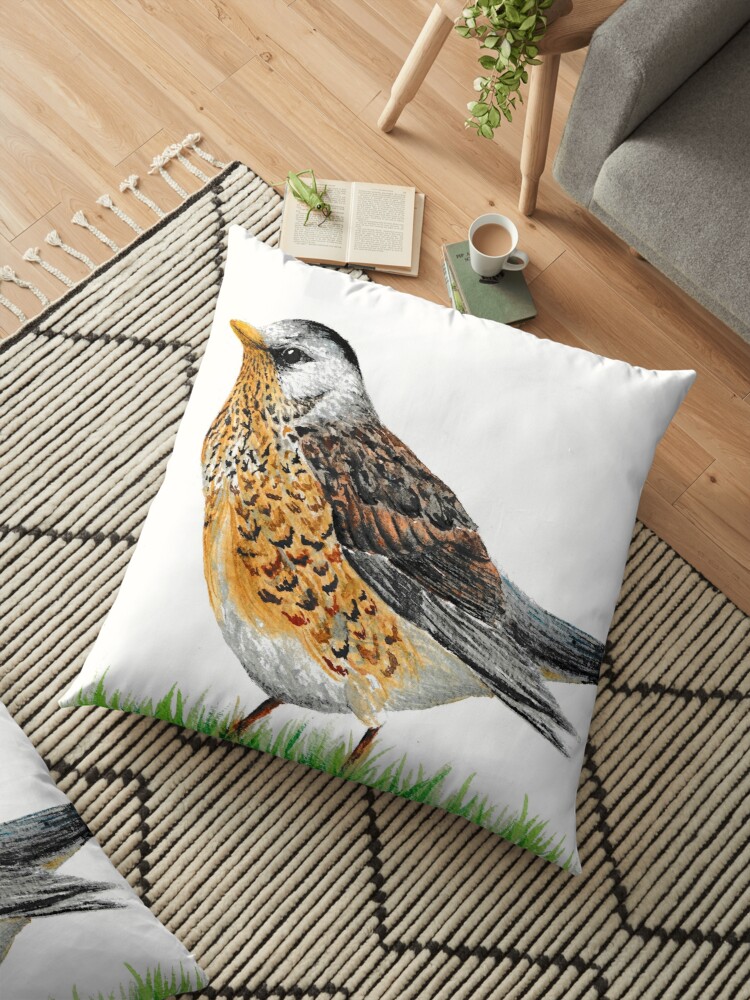
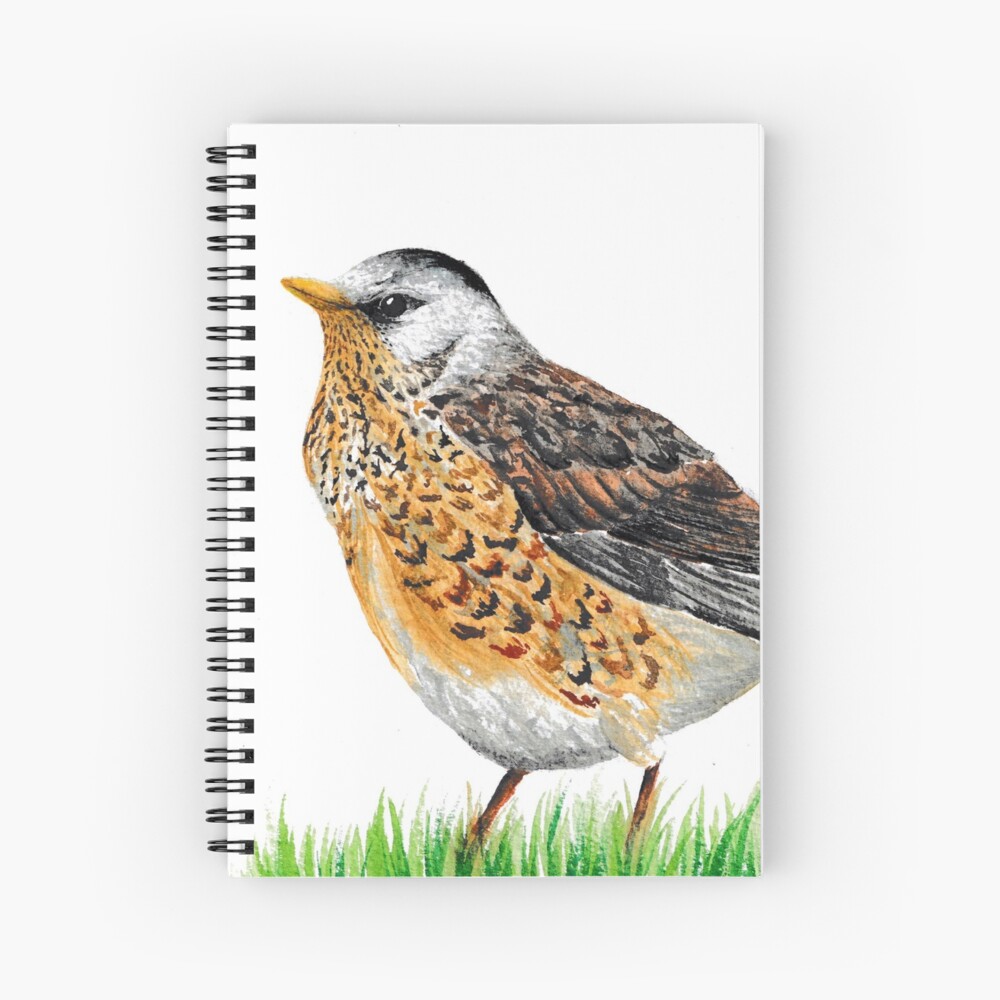
The pretty fieldfare is the newest addition to my Beautiful Birds collection on Redbubble. If you’re interested, you can check her out here. Thanks for reading!

Love, Claude & Jolene

Last November, I briefly introduced two new arrivals to my life: Claude and Jolene. We adopted this bonded pair of cats from Warwickshire Cats Protection. 

Since that rather turbulent car journey home, our cats abandoned their old names – Claude (white and grey male) was previously called Snowy and Jolene (black female) was called Misty. I have a little chuckle when I think about these old names. Claude is definitely not a ‘Snowy’ and ‘Misty’ isn’t sassy enough for Jolene. My partner definitely gets the credit for their names though. I wanted to call Jolene ‘Daisy’ but she definitely ain’t a ‘Daisy’!

The reason I’m banging on about my cats – and, yes, I have indeed become one of those cat people who constantly takes photos and videos of them both – is because, through their endlessly entertaining ways, they’ve inspired a new cartoon collection.

Seasonal stints

We picked Claude and Jolene up in October. As I alluded to, it was a rather painful car journey and I think we all thought it was a miracle that we’d survived it. On top of that, in addition to cleaning up a couple of traumatised cats that day, we also had to rescue an injured pigeon from our garden. As unlikely as it sounds, I promise that this had nothing to do with the cats. It’s a side story that deserves more airtime but, to give you the short version, I somehow led an injured pigeon into our garden. After several attempts, I managed to catch it and put it in a large box. Then we had to work out what to do to help it. Turns out, local Facebook groups are absolutely top notch for finding help on ‘the day of rest’ if you end up with an injured pigeon in your garden! 

The next couple of days involved Claude spending most of his time either down the gap by the washing machine, in the gap by the sofa or on top of the boiler. Jolene was more adventurous but she was only really interested in food (and, to some extent, still is!) Over time, they began to settle more and I started to see their true characters.

As Halloween was approaching, I decided to try and draw a simple – but suitably spooky – cartoon featuring this cat couple. I mainly wanted to get the cat shapes right. Drawing a simple cat turned out to be quite a challenge (they kept looking like dogs and squirrels…) but I got there in the end!

Later in the year, as my Christmas holidays started, I thought it would be fitting to draw Claude and Jolene in a more festive scene. They both love to play with toys and they both always investigate new objects in the house. Over Christmas, various boxes would suddenly appear in our living room and they always had a good sniff and rubbed their cheeks against them. 

Claude – when he’s not sleeping – loves to jump over/onto things. He regularly jumps on Jolene and sometimes even leaps over her. So I knew he needed to be crouched, ready to pounce. Sassy Jolene, on the other hand, is all about the ball toys we have. When it comes to anything else, she goes hot and cold. One minute, she’ll go crazy and will start scratching and running around the toy (or box). Next, she’ll sit next to the toy (or box) and will timidly reach out to pat it. I thought I’d save the ball toys for another time so I drew her reaching her paw out to touch the box. I guarantee you that if you could see a ‘what happened next’ drawing, she would be scratching the presents, they would all have toppled over and she might even be trying to climb up the tree!

Daily Routines

Both kitties definitely have some entertaining quirks and what better way to demonstrate these than to draw out various aspects of their daily routines! Here’s what I’ve done so far.

7:00am: The start to the day is what initially inspired me to draw Claude and Jolene’s daily routines. It makes me laugh every morning. Bleary-eyed and groggy, my partner and I take it in turns to give them their breakfast. Whether it’s him or me, one thing is guaranteed. At 6.55am when we wander into the kitchen to dish up the goods, Jolene can be heard meowing right behind the door of their room downstairs. 

I have absolutely no idea how long she sits behind the door for but I have a suspicion it could be a long time – she’s like an old lady waiting by the door to be picked up to see the family (my grandma used to be like that!) Though we don’t know for sure, using some detective skills, I’m confident that Claude usually stays in his bed for a little longer. How do I know this? His bed is usually still warm when I go into the room.

As soon as they smell the food being dished up, Jolene’s meowing gets more persistent and she starts scratching the door. Claude also meows every now and then but he usually just parrots Jolene and I’m convinced that he’s simply mesmerised by the smell of the food, jumps off his bed and joins Jolene by the door. The cartoon captures this precise moment.

What happens next is arguably more entertaining. As soon as we open the door, they both spill out into the hallway. Jolene looking up at the food bowls and meowing like a demon, Claude sometimes leaping over her and almost running around in circles. That was a bit too ambitious for me to draw but you can see a video of this on Instagram.

9:00am: Later in the morning, I normally go and check on the cats. Almost every time I go down the stairs to their room, I hear a small thud as Jolene jumps off the sofa and goes to the door. There’s only really one reason why Jolene wouldn’t be at the door when I open it: she’s outside. But that’s quite rare during the day!

As I open the door, Jolene usually pops her head round, uses her paw to push past the door, makes a very odd noise (like someone saying ‘and where have you been’) and then legs it past me. Claude, on the other hand, is usually asleep in his bed, on the sofa, or, more bizarrely, in the utility area next to the sink. 

After experiencing this part of their daily routines a few times, I genuinely started to think that Jolene must never sleep. Before we got them, I’d read that cats can sleep for up to 16 hours a day. Claude was definitely sleeping quite a bit but I’d never seen Jolene asleep. More recently, I’ve been proven wrong. Jolene definitely sleeps but it’s very light – as soon as there’s any kind of noise, she opens her eyes and tries to work out what she’s missing out on!

Coming up…

More cartoons coming soon. I’ve noted down some ideas for other aspects of Claude and Jolene’s daily routines and I can confirm that there’s definitely a lot of source material!!! They’ve also inspired a birthday card for my ‘Little Sister’ who I support through the Big Brothers Big Sisters project 😊

#12DaysWild

In June 2020, I decided to take part in The Wildlife Trusts ‘30 Days Wild’ challenge. The general idea was to appreciate nature – and the positive effect it has on wellbeing and mental health – through daily ‘acts of wildness’.

I started taking more of an interest in The Wildlife Trusts during my last ever pre-lockdown holiday in Norfolk. In an attempt to stay local while we were there, we looked online for some nearby beauty spots to explore and found the Norfolk Wildlife Trust website. My partner then very kindly gave me an annual subscription for my birthday and I was delighted to see that a similar challenge was running over 12 days from the 25th December. So here’s a summary of what I got up to.

Day 1: 25th December
We had a lovely wintery walk on Christmas Day morning and, after having a genuinely outrageous portion of Christmas dinner, we had another short stroll around the town. What I really enjoyed about this shorter walk was all of the blackbirds we heard squawking in the darkness. The RSPB book notes that blackbirds are ‘common’ and I think that’s an understatement – their website says that there are over 5 million breeding pairs in the UK!

Blackbird – RSPB Pocket Guide to British Birds

Day 2: 26th December 
Boxing Day wasn’t the best weather-wise so I ended up reading a good chunk of Alys Fowler’s Hidden Nature: A Voyage of Discovery about her adventures on the Birmingham Canal network. Aside from giving me romantic thoughts about walking the canals and investing in a kayak, I learnt quite a bit about eels in this chunk. Did you know that all of the eels in Britain were actually spawned in the Sargasso Sea (part of the Atlantic Ocean) and then they travelled to us? I didn’t know this. Not sure how they end up in canals though!

Hidden Nature, Alys Fowler

Day 3: 27th December
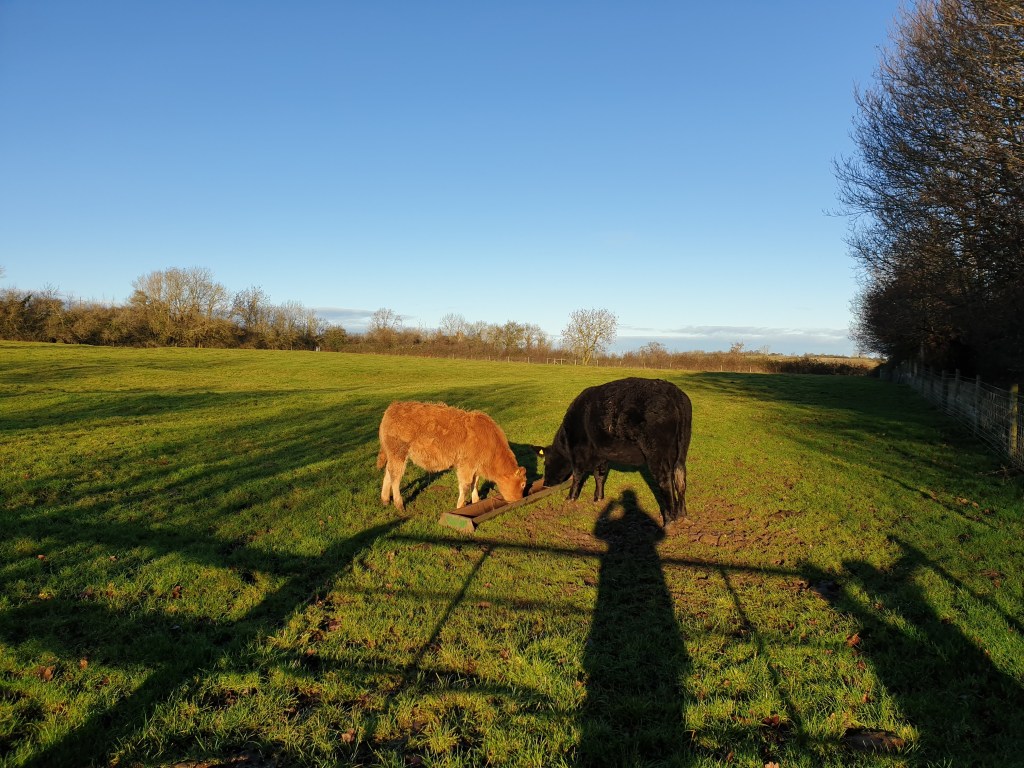
After some very heavy rain, we went for a road walk today. It’s just too wet and muddy to go through the fields at the moment, but we found a lovely road-route through some nearby villages (Barcheston, Willington, Burmington and Tidmington). The weather was cold and sunny – a perfect wintery morning – and the highlight was definitely seeing a beautiful cow and its calf in one of the fields (photo credit: Stefan Lang).

Day 4: 28th December
I finally finished a watercolour painting of a long tailed tit today. It was inspired by a trip to Warwickshire Wildlife Trust’s Ryton Woods just before Christmas. We had a very muddy walk here and there were lots of long tailed tits flitting between the trees – I’m sure they were laughing at us struggling through the bog!

A touched-up scan of a watercolour long-tailed tit

Day 5: 29th December 
A visit to another Warwickshire Wildlife Trust reserve was the highlight of today. This time it was Brandon Marsh near Coventry. The pools at this reserve always offer up some interesting birdlife. This time the highlights were: a jay, tufted ducks, shelducks, cormorants, a heron, all manner of tits, countless robins and some magnificent swans that kept waddling and flying between the pools (photo credit: Stefan Lang).

Day 6: 30th December 
A snippet from my BBC Wildlife Magazine was the ‘act of wildness’ for today. This issue has a very uplifting feature that highlights the conservation success stories of 2020. The first one is about the grey seal population at Blakeney National Nature Reserve which I was lucky enough to visit in early March 2020. Apparently, an estimated 4,000 pups were born there last year! If you’d like to see a free, slightly shorter list of conservation success stories, check out this post.

’50 Reasons to be Cheerful’ in BBC Wildlife (January 2021)

Day 7: 31st December 
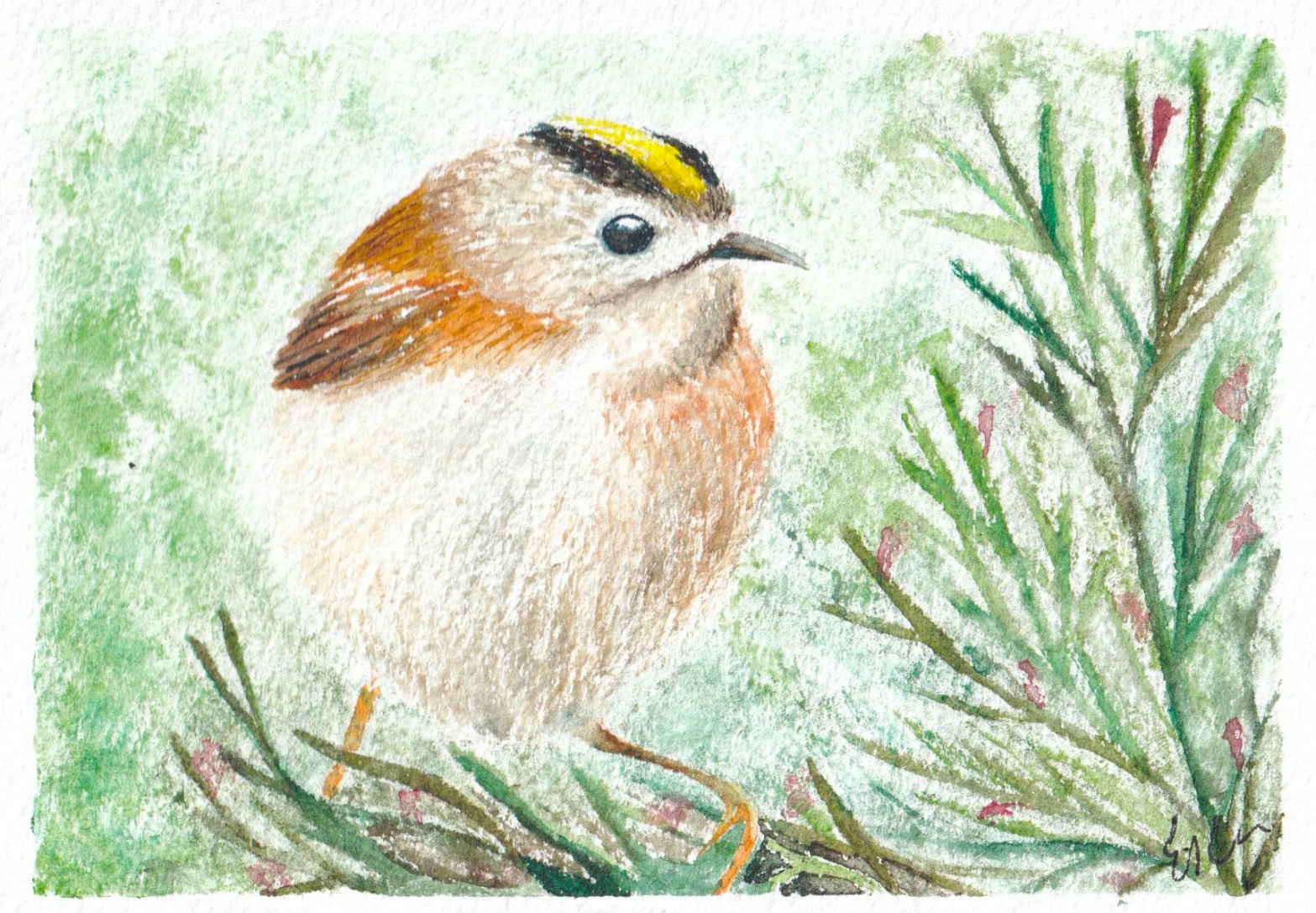
Today was another painting day. I usually procrastinate in the morning but I decided to get motivated and crack on with a new art piece. It was a goldcrest this time. I’ve written a longer post about this bird but, to give you the short version, it was inspired by a real life goldcrest that I saw on a local (and muddy!) walk in November.

Goldcrest watercolour

Day 8: 1st January 
I did something a little bit different today. We’ve been for lots of local short walks over Christmas but the weather was rubbish so I decided to look at some of the suggestions The Wildlife Trusts had sent over about ‘12 Days Wild’. I opted for a virtual tour of a Warwickshire nature reserve that I hadn’t visited before: Bubbenhall Wood and Meadow. Hearing that the reserve has 43 different species of birds, 19 different species of butterflies and lots of wildflowers (including bluebells!) has added it firmly to the list of places I’d like to visit in spring!

Screenshot of the Warwickshire Nature Reserves YouTube channel

Day 9: 2nd January 
It’s getting scarily close to ‘back to work’ time so we made the most of the dry weather and set off on a 10 mile walk from home. This time, we opted for a road walk from Shipston to Whatcote. The first bit was next to a national speed limit road so that wasn’t very fun, but the other 9 miles or so was on quieter single-track roads. We went through Honington first and then on to Whatcote and back. Highlights of the walk included seeing a buzzard, kestrel and a greater-spotted woodpecker (photo credit: Stefan Lang).

Day 10: 3rd January
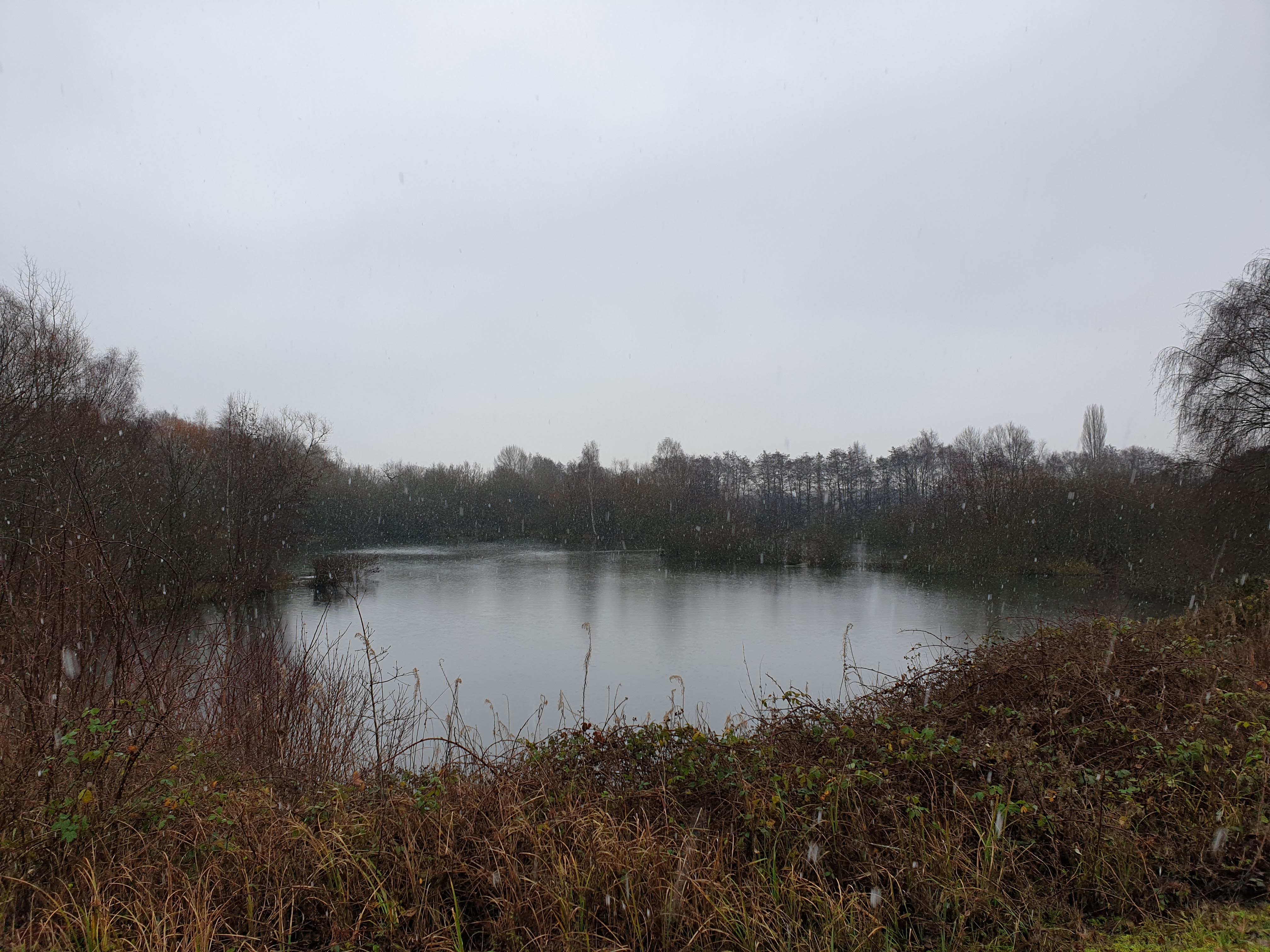
It’s safe to say it’s been quite a food-heavy Christmas and I was craving a jog this morning. Once you get going, there’s something quite invigorating about going out for a jog in the cold and the dark. I misjudged the cold a few weeks ago and went out for a jog in what turned out to be freezing fog – I kid you not, I had ice crystals in my hair by the end of it! This time, it wasn’t actually as cold as I thought it might be. And, big bonus, I managed to beat the sleet that arrived shortly after I got back!

The view outside before I started the jog!

And, just as a side note, I also had a look at some suggestions from The Wildlife Trusts about how to reduce waste after Christmas. One idea that caught my eye was to cut up Christmas cards into pieces and use them as gift tags next year – I thought this was a fab idea!

Day 11: 4th January 
It was another artwork day today and this time I focused on the fieldfare. At the start of winter last year, I was walking my usual route through the nearby meadow and noticed a group of birds making quite a racket. They sounded like parakeets but I knew that wasn’t possible! They also looked quite colourful but they kept flying off when I tried to get closer so I kept on walking and pondered what they could be. When I got home, I looked in the bird book and wondered whether they could be fieldfares. Having seen them quite a few times since, I can confirm that they definitely are!

Fieldfare watercolour

Day 12: 5th January
The last day of ‘12 Days Wild’ and the first day back to work. To help break up the day, I had a listen to a BBCs podcast called 30 Animals That Made Us Smarter. I started listening to this back in the March lockdown but there were a couple of episodes that I missed. This one was about the blue morpho butterfly and how, despite its striking cobalt-blue colour, its wings don’t actually contain any blue pigment. Instead, the mosaic of scales that make up the inside of its wings are positioned in such a way that refracts the light so that our eyes see a blue colour. This butterfly has inspired new approaches to paint and textiles, partly in a bid to cut pollution from dye and paint production. Apparently a new range of car paint based on this approach has already been developed and it changes colour as the car moves!

Screenshot of 30 Animals That Made Us Smarter podcast

Hope you’ve enjoyed reading my #12DaysWild diary. I would really recommend having a go at a ‘random act of wildness’ every day – it’s done wonders for my wellbeing!

Other Useful Links
The Wildlife Trusts (general info) – https://www.wildlifetrusts.org/
Local Wildlife Trust Tool – https://www.wildlifetrusts.org/find-wildlife-trust
Discover Wildlife (podcasts and articles) – https://www.discoverwildlife.com/
RSPB (bird and wildlife info) – https://www.rspb.org.uk/birds-and-wildlife/


Regulus regulus

I recently learnt an interesting fact. I sometimes joke with my friends that when I learn something potentially dubious, I’ve learnt a myth. I think we may even have laughed about this before ‘fake news’ started becoming the way of describing such pieces of information. In any case, I think this interesting fact is undoubtedly credible. 

This post is about the UK’s smallest bird: the goldcrest. And, according to Discover Wildlife, the goldcrest is one of a handful of birds whose scientific name is a tautonym. A tautonym is when the scientific name is identical for the genus (the first part) and the specific name (the second part). In the goldcrest’s case, this is Regulus regulus.

Goldcrest from the Discover Wildlife article about tautonyms

My partner and I were lucky enough to see a goldcrest on a walk in November. We’d just been talking about goldcrests, as I’d read an email from the Warwickshire Wildlife Trust which mentioned that winter is a good time to look out for these 6g critters (side note: apparently 6g is about the same weight as a 10 pence piece – mind. blown.) We were walking on a footpath by the side of a busy road. Next to the footpath was a line of coniferous trees and, as we were passing one particular conifer, we saw a teeny tiny bird flitting around. We stopped for more of a look and were delighted to see a revealing gold line on the bird’s crown, confirming its identity.

It was a very special encounter and I wish I had some proof of it. Sadly – and hilariously! – my partner did get his phone out to record the goldcrest. We were so close to it that it was recordable. However. Slight issue. He didn’t press record until the very end when the bird had flown further into the tree. So all he’d recorded was his finger and me saying ‘that was good’. I think I was almost on the floor in a fit of giggles when I realised what had happened!

The walk was a long one (10 miles!) and I remember it being very muddy in places. But the thing that still sticks out the most is the beautiful goldcrest. And, particularly as we ‘lost’ the video footage, it’s been on my art-list since our November walk. 

I started as usual by drawing out a vague outline of this little bird. I didn’t take a photo of this stage of the process but I was having a few doubts by the time I’d finished the outline. I imagine it’s something that gets easier with practice, but I still find it difficult to picture what the final piece will look like – and whether it’ll look right – before I’ve started adding colour and shade. A pencil outline isn’t very much to go on!

I wanted to use my Winsor & Newton pocket watercolour set for this piece. I tend to use watercolour tubes, but I’ve found that these can sometimes be a bit wasteful (usually because I don’t accurately predict the amount of paint I’m actually going to use!) so I got the 12 half pan set out. 

Instead of wetting the paper first, I decided to try a different approach. I’ve seen lots of bird artists on social media make use of the white of the paper in their work and I thought more about what the piece would look like from a distance than up really close. Shapes and colours are really important to this so I tried to ignore most of the detail and refocused my attention. I also used the roughness of the paper to add texture to the bird’s feathers.

The finished goldcrest – still stuck onto the painting board

I made sure to add a bit more detail to the bird’s eye and beak and then moved on to the tree. Now, you might say that the background should’ve been done first and, to be honest, I’d completely agree with you. Thing is, I didn’t decide until I worked on the greenery that I didn’t want a white background so I had to improvise. Quickly. So I started splashing on some of the greens and browns from the watercolour set and, with no other bright ideas, I used my finger to spread the colour out. Mercifully, it worked. 

Does that mean I’ve learnt another myth fact?

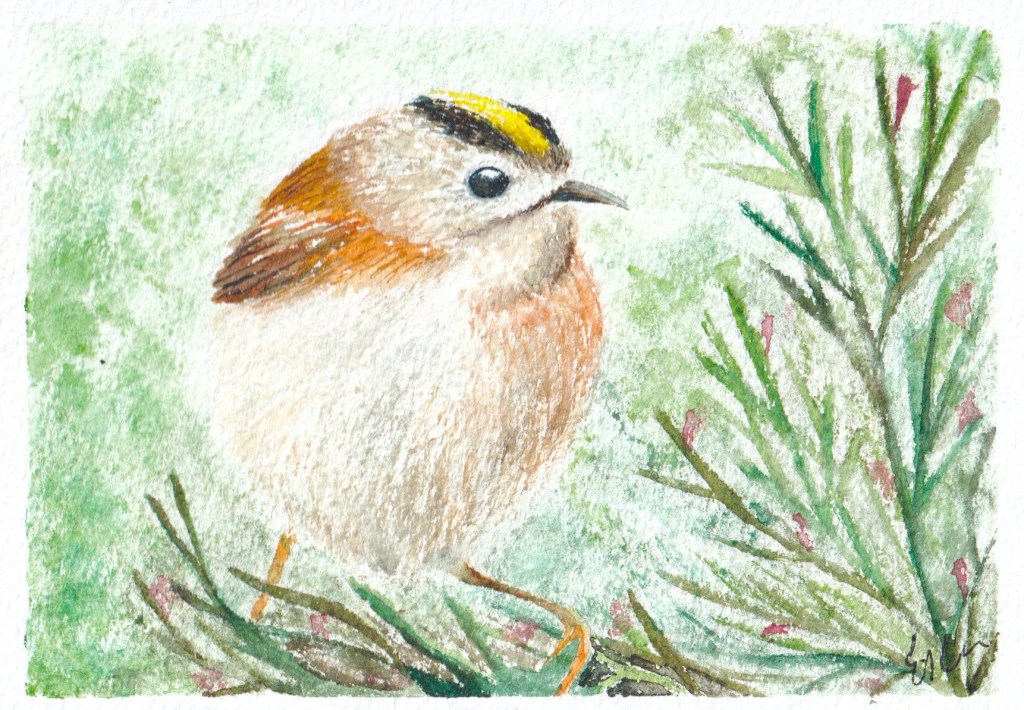
A scan of the final piece

“No cheeses for us meeces”

Quite possibly the best line of any Christmas film.

(For those of you who haven’t been blessed with the quote yet – or the song it comes from – I would highly recommend watching this clip from A Muppets Christmas Carol.)

As it happens, this post actually has nothing to do with cheese or mice but it does have something to do with Christmas. So, from that perspective, the title still totally makes sense!

So what could be better than cheese or mice? Well, I wanted to share a few Christmas presents that I painted this year.

Mr Snowman

I recently shared a post about some snowmen I sent out to friends and family. In addition to these, I decided to draw a slightly larger snowman as a present for my ‘Big Brothers Big Sisters’ sibling. I volunteer for this amazing Oxford Hub project and wrote earlier in the year about the things I did to keep up contact with my ‘Little Sister’ during the first lockdown. Luckily, I was able to see my ‘Little Sister’ in September and October. I was a bit worried that lockdown might’ve been too disruptive – I used to see my ‘Little Sister’ pretty much every week and a gap of 5 months was therefore a lot – but it was like nothing had happened. We went to the park, got some milkshakes and talked about our cats.

Things have changed again since then so I haven’t seen my ‘Little Sister’ for a while and I wanted to make sure she got a nice Christmas present from me. So Mr Snowman wished her a Merry Christmas on my behalf on Christmas morning. I should add that I also sent her a chocolate lolly for good measure!

Savanna scene

This piece was for my partner. As supportive and wonderful as he is, he does have a rather inconvenient birthday – Christmas Eve! Nothing he can do about it and, to be fair, I wouldn’t really change it. I just enjoy teasing him each year!

That said, trying to think of ways to make a Tier-3-birthday interesting the day before a Covid-Christmas was a bit of a challenge. I usually opt for ‘experience’ presents and that just wasn’t an option this year…! 

I painted something for my partner for his birthday in 2017. I remember it being quite a stressful experience. I usually worked on it in our little flat (when we were still living in West Oxfordshire) while my partner was out playing football on saturday afternoons. I agonised over every detail and added something in at the last minute. It ruined the whole picture. I remember crying all afternoon trying to work out how I was going to do it all again in only a couple of weeks. I managed to do it, but, to be honest, it’s quite funny looking back now. It was definitely a gift where the thought counted, but, looking at my work from this year, I really didn’t know what I was doing with watercolours back then so the quality wasn’t great!

My partner has said previously that he would love a savanna scene so I did some research and drew out what I thought was within my capabilities. I’m still pretty nervous about drawing and painting new, unfamiliar things so I wanted to attempt something realistic. This is an A5 piece so I picked a couple of iconic animals to feature (the giraffe and a gazelle), along with typical savanna grass, shrubs and trees. 

I began with a simple watercolour layer. When I started the piece, I wasn’t exactly sure about which materials I was going to end up using. I was considering using ink over the watercolour layer like in some of my other landscapes but I thought that might be a bit too harsh. Instead, I added pencil crayon to the foreground. I wanted attention to be drawn to this section so I left the watercolour background untouched and prayed that the detail of the giraffe and gazelle would shine through!

Ingleborough in watercolour and ink

This final piece was for my mum and dad. It was a bit of a gamble but I did decide to layer ink on watercolour for this one. I say gamble because I think ink looks best where there’s a lot of intricate detail. The picture is of Ingleborough and, in my limited experience, this sort of landscape didn’t really strike me as having a lot of intricate detail.

That said, I found a useful photo of this Yorkshire mountain with a dry stone wall in the foreground. This wall reminded me a lot of the windmill and derelict barn I drew on top of watercolour earlier in the year so I decided it was worth a go.

Like the savanna scene, I started with the watercolour layer. I decided to be quite loose with this and only directed the colours very vaguely around the key features of the picture. I then drew the outline of the dry stone wall. I started with this because it’s the defining feature of the piece – your eyes are immediately drawn to it.

Satisfied, I moved onto Ingleborough itself. I looked at its scars and crevices and drew them out in ink. I was very careful with this. I didn’t want the mountain to end up being solid black and I thought there was a serious risk of that happening – I love working with pen but it can be tempting to add ‘just one more line’ and, before you know it, you’ve got a solid black object that is irreversibly ruined.

I didn’t add as much detail to the middle ground but drew lots of ink onto the dry stone wall in the foreground. Though I drew out this section first, I didn’t add detail until the very end. I really enjoyed this bit, but I still had to be careful with my pen and didn’t want to make the wall too dark.

I’ve never walked up Ingleborough but its iconic flat top always reminds me of home and the brilliance of the Yorkshire Dales!

There’s one final piece I’m planning to share with you but I can’t just yet. Due to some postal delays, the recipient hasn’t received their present yet so I look forward to sharing it with you soon!

(And, to bring this post full circle, I can confirm that there have been plenty of cheeses for us meeces this Christmas!!!)

Do you want to build a snowman…

(…Another lyric that just wouldn’t leave my head! I hope you’re a fan of this Frozen song. If not, I can only apologise!)

Just a short one from me this weekend. Over the past few weeks, I’ve been busy with a couple of Christmas projects and I wanted to share this one with you.

I sent out homemade Christmas cards in 2019 and wanted to do something similar this year. But, as I’m not able to see many friends or family members this Christmas, I wanted to post something out that could be kept. So I decided to create some small snowmen watercolours. 

I wanted the final pieces to be A5 in size so I opted for 6” by 4” watercolour paper and bought some small mounts, backing boards and wrappers so that I could give them a semi-professional finish. I’ve mounted a few pieces this year and have definitely improved my technique but I hadn’t put backing boards on any pieces before so it was a bit of a learning curve!

I drew out the basic design of the snowman in a soft pencil and then painted on the watercolours. I wanted to add a bit of variety and a personal touch to each piece so I mixed up the colours of the hat, scarf and buttons (although I think mine look less like buttons and more like stones). I then added some fine liner over the design to finish it off.

One of the snowmen with its watercolour layer

With around 15 to complete in total, I was on a pretty tight schedule and got into a strict routine so I could complete the project before and after work over a couple of weeks.

I had a lot of fun with these snowmen and they really helped me to get into a Christmassy mood! The only slightly stressful moment – and I am rather neurotic at times – was when I posted the snowmen out. I must’ve checked that the postage was correct about a million times and was still convinced that I’d got it wrong and was about to annoy 15 people/families! Luckily that didn’t happen!

Merry Christmas everyone! 🎄☃️🎁

One of the finished snowmen – mounted, backed and packed 😊

Paco the Toucan

A very close friend of mine recently asked me to draw something for him. I always get a bit nervous when I’m drawing or painting something specific for someone. The perfectionist really does start to freak out!

Luckily he asked me to draw a bird and I’ve drawn quite a few birds this year so it was definitely within my comfort zone. His bird of choice was a toucan.

I was a bit torn about which materials to use for this one. My friend’s request was to have a bit of a mixture, so I started with watercolour, then added pencil and then tried out some pen on it. I tested a few methods out on the head and sent some photos over to my friend to see which took his fancy. Watercolour and pencil was the preferred option.

I didn’t realise that there were so many different toucans out there. According to Britannica, there are 35 different species in the toucan family. The toco toucan features in this piece – one of the larger toucan species. 

South American tropical rainforests are the toco toucan’s home. Though it’s rated as ‘least concern’ by the International Union for the Conservation of Nature, numbers of tocos are declining. According to National Geographic, this is partly because they’re hunted for food and, horrifically, they supply the pet trade. 

Draft 1 of Paco the Toucan

My favourite bits to work on were the beak – it’s quite magnificent! – and the dark plumage. The latter might be a bit surprising but I used lots of colours in these feathers. I started with prussian blue watercolour paint and then added burnt umber (a type of brown). I also mixed in the colours I’d used on the beak into the blue-brown mixture (cadmium yellow hue and cadmium red pale hue). After the watercolours, I layered on some dark indigo, warm greys and black Faber-Castell pencils. I prefer to use a mixture of colours for dark shades rather than black from the very start.

Paco the Toucan – the final piece

I was over the moon to hear that my friend loved Paco! Creating him was very therapeutic in November and he’s one of my favourite bird pieces!

Autumn Vibes

I’m writing this with the absolute knowledge that all of the leaves have already fallen off the cherry tree in the garden. Some might say that I’ve almost missed autumn, but I absolutely love autumnal colours and have been meaning to paint them – and write about them – for the best part of 2 months. So please humour me while I talk you through these pieces 😋

Autumn Berries

Like much of my artwork, this one began with a walk. I was on my way to the meadow in October when I was absolutely mesmerised by the bright red berries in the hedgerow. I had been in my own little world as I went through the gate leading to the track and these colourful fruits snapped me straight back to reality. It was a surprisingly good mindfulness tool. 

As I’d initially walked straight past, I did a double-take and looked back at them to get a proper view. I quickly glanced around past the gate and saw a couple of other walkers were not far behind me so I scurried off, not wanting to embarrass myself by retracing my steps to look at some berries.

I made a mental note that I had to take a photo of the berries the next time I walked past them though. And that’s exactly what I did.

Acer Tree Leaves

We’re very lucky to have a beautiful acer tree in the garden. Its characteristic leaves turn all sorts of colours in autumn so, when I came back from a longer walk earlier in November, I went straight to the garden and took some photos of it in all its autumnal glory. 

In the process of doing this, I seriously confused my two cats. They live in a room on the ground floor that looks out onto the garden and therefore have full view of what goes on out there. As soon as she saw me, my female cat – Jolene, a beautiful black cat – jumped straight up onto the window sill and bobbed her head up and down, looking at me. Trying to work out how I got there. My male cat – Claude, a very large white and grey tabby mix (think snow leopard meets snowman) – just looked at me from his bed and meowed. 

Despite confusing the cats, I knew that the acer had to be added to my autumn collection. The reds and purples are just too beautiful to be missed.

Beautiful Blackberries

My penultimate piece is another berry. That juicy autumn berry that you find on hedgerows everywhere at the right time of year. I took the photo for this one in early November as well so I was surprised to see that some of the blackberries were still red. To be honest, from the many local walks I’ve done with my partner this year, the blackberries seem to ripen much earlier than I remember from childhood. We talked many times about picking some but seemed to miss the boat when we didn’t do it in September!

I loved painting the reds, purples and blacks in this piece. The contrast between the unripe, ripening, and totally ripe berries is, I think, a true symbol of autumn. 

Snowberries

I don’t understand how I’ve lived on this planet for nearly thirty years without knowing that a plant called a snowberry existed. Lots of plants have complicated names that are difficult to remember, but, when I looked up this final plant that had caught my eye, I couldn’t believe it was so simple. Snowberry. The berries look like snowballs. So they’re called snowberries.

I spotted these on the way back through town and, like the others, their striking shapes and colours caught my eye. The bright white contrasts beautifully against the greens.

I might be cheating a bit with this one. It’s not necessarily strictly autumnal but it does emerge in November so I’m going to say that counts. We’re nearly in winter so I doubt it matters anyway!

Materials & shop

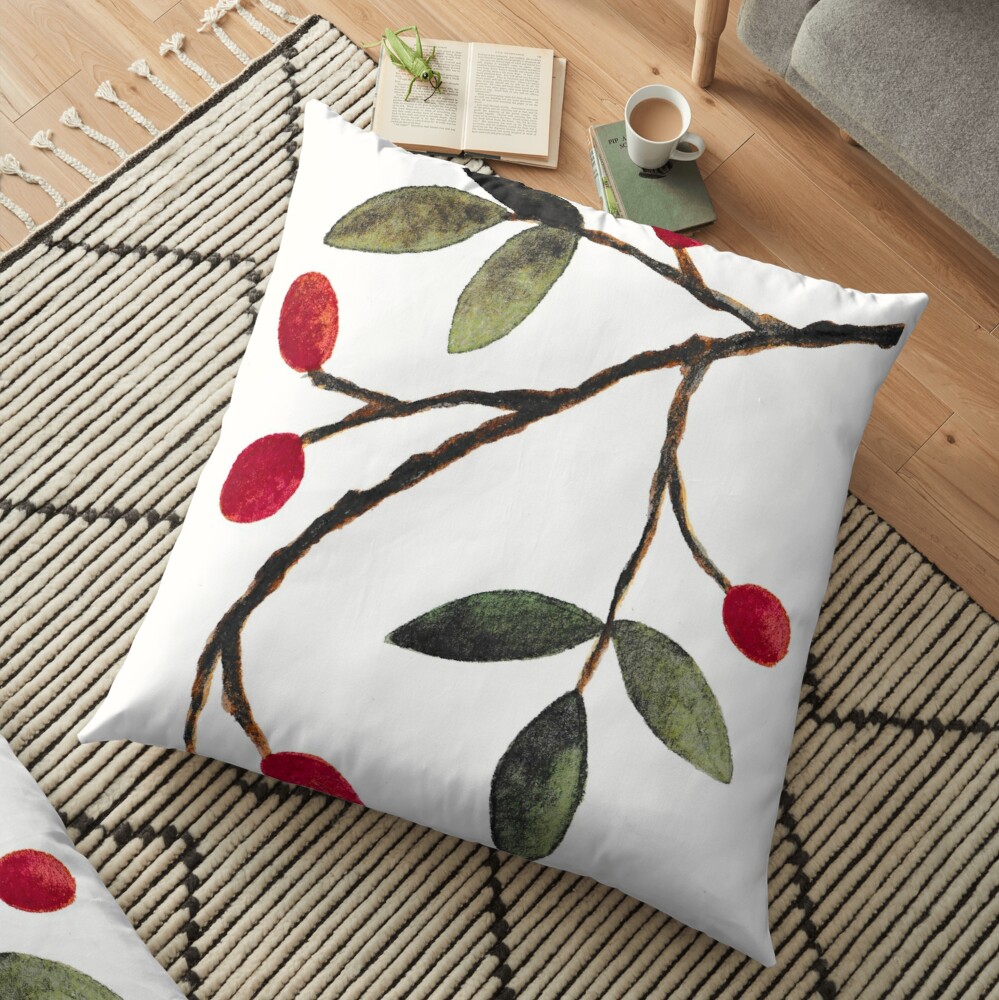
I used Winsor & Newton Cotman watercolours and Faber Castell Polychromos pencils for each piece and they all now exist in my Autumn Collection on Redbubble 😊

Off the Beaten Track

I’m really enjoying a particular style of artwork at the moment. Watercolour background and fine liner pen foreground. And I’ve found that it suits some particular sites that I’m drawn to when I’m out on walks: old dilapidated buildings.

These sorts of buildings always mesmerise me. I love seeing old ruins but there’s something about seeing a building that, not too long ago, was occupied and had a purpose and is now falling apart. It sparks a bit of a morbid fascination. A true reflection of the power of time and how it changes the landscape.

A scan of Off the Beaten Track – watercolour and fine liner on A5

This particular building – I’m guessing a barn or an old farmhouse – was spotted not too far from Harlech in Wales. My partner and I were going on what turned out to be a bit of an epic trek. During lockdown, we got into the swing of visiting smaller, more local nature reserves and I’d spotted a North Wales Wildlife Trust reserve not too far away from where we were staying. It’s called Coed Crafnant.

I optimistically plotted out a walk that would take us to the reserve cross-country. My Ordnance Survey app said it was just over 6km long and would take just over an hour and a half to walk. Now, using OS to plot local routes has undoubtedly been very useful over the past few months. It really does take you off the beaten track and lets you explore places you’ve never noticed in your local area before. That said, it did stitch me up this time.

The route to Coed Crafnant

We did the walk on our last day of holiday in Wales and so my partner and I both feared the approaching shadow of ‘negative time’. We set out reasonably early and got Harlech hill out of the way – it’s so steep! Unlike our other treks into the town, though, we had to continue scaling the hill. We climbed up and up until the road ended and the fields opened before us. We then passed a tree which seemed to offer a home to all manner of birdlife: robins, blue tits, woodpeckers, finches. 

And this is where we first got stuck (note the word ‘first’). Couldn’t find the way over a dry stone wall to save our lives. Even the OS app couldn’t help with that. After walking around in circles for a few minutes, we finally spotted some sort of style over the wall and continued up the hill. Though it was hard on the legs, the views of the coast were genuinely incredible.

Coastal views at the top of the hill (Credit: Stefan Lang)

The rest of the route took us past various streams, hills, fields, tracks, and, of course, a few dilapidated buildings. We got lost a few more times on the way so, to cut a long story short, we only stayed at the reserve for about 20 minutes and walked back along the road (the most direct route) to Harlech for a well-earned ice cream. It had felt like a very long, but beautiful, walk to Coed Crafnant. Definitely longer than 6km!

A stream just outside the Coed Crafnant Nature Reserve (Credit: Stefan Lang)

In addition to the coastal views, the old farm buildings are the images that stuck with me. The exposed beams were particularly striking. It’s like seeing a human skeleton. You know everyone has one, but you also know that you’re not really supposed to see it!

The derelict barn (Credit: Stefan Lang)

I started off the piece by sketching out the picture and then created a moody background. Though it was a beautiful, sunny and warm September day when we walked past the building, I thought about what it may look like in the middle of winter. All exposed and alone. I decided to start with yellow ochre watercolour paint and then added a few splashes of ivory black to channel some of that midwinter light.

The watercolour background

I then used a mixture of 0.03mm and 0.1mm fine liner pens for the building, stone wall and grass. I tried to bring out the detail of the building and the stone wall in the simplest and clearest way. I didn’t want to add too much pen because, from a distance, I knew the shapes would all merge together and this wouldn’t look very good. I also thought carefully about the grass. I wasn’t satisfied with the grass in my Lonely Windmill piece so I tried to blend the grass into the background to add a more subtle effect.

Stage 1 of the fine liner foreground

Next up, I think I’ll look through some other holiday and walk photos to draw a couple more pieces to add to this collection. Maybe something with a brighter feel to it…

If you’re a fan of this piece, it’s now available in my online shop. Some examples of the products available are included below 😊

Design a site like this with WordPress.com
Get started